Reversal Structures Replay Practice Guide
Stop fading every trend pause and learn to confirm a real structure shift before calling a reversal, using replay practice.
Key Takeaways
- Reversal structures need trend failure, structure shift, and follow-through.
- Most bad reversal calls come from fading a strong trend too early.
- Replay is useful because it slows the moment before confirmation becomes obvious.
- The best review note explains what had to break before the reversal call was valid.
Reversal structures replay practice is about learning when a trend has actually changed behavior. It is not about calling tops and bottoms because the move looks stretched.
A real reversal structure usually needs three things:
- the prior trend starts to fail
- market structure shifts against that trend
- follow-through confirms the new direction
Without those pieces, many reversal attempts are just early fades inside a still-valid trend.
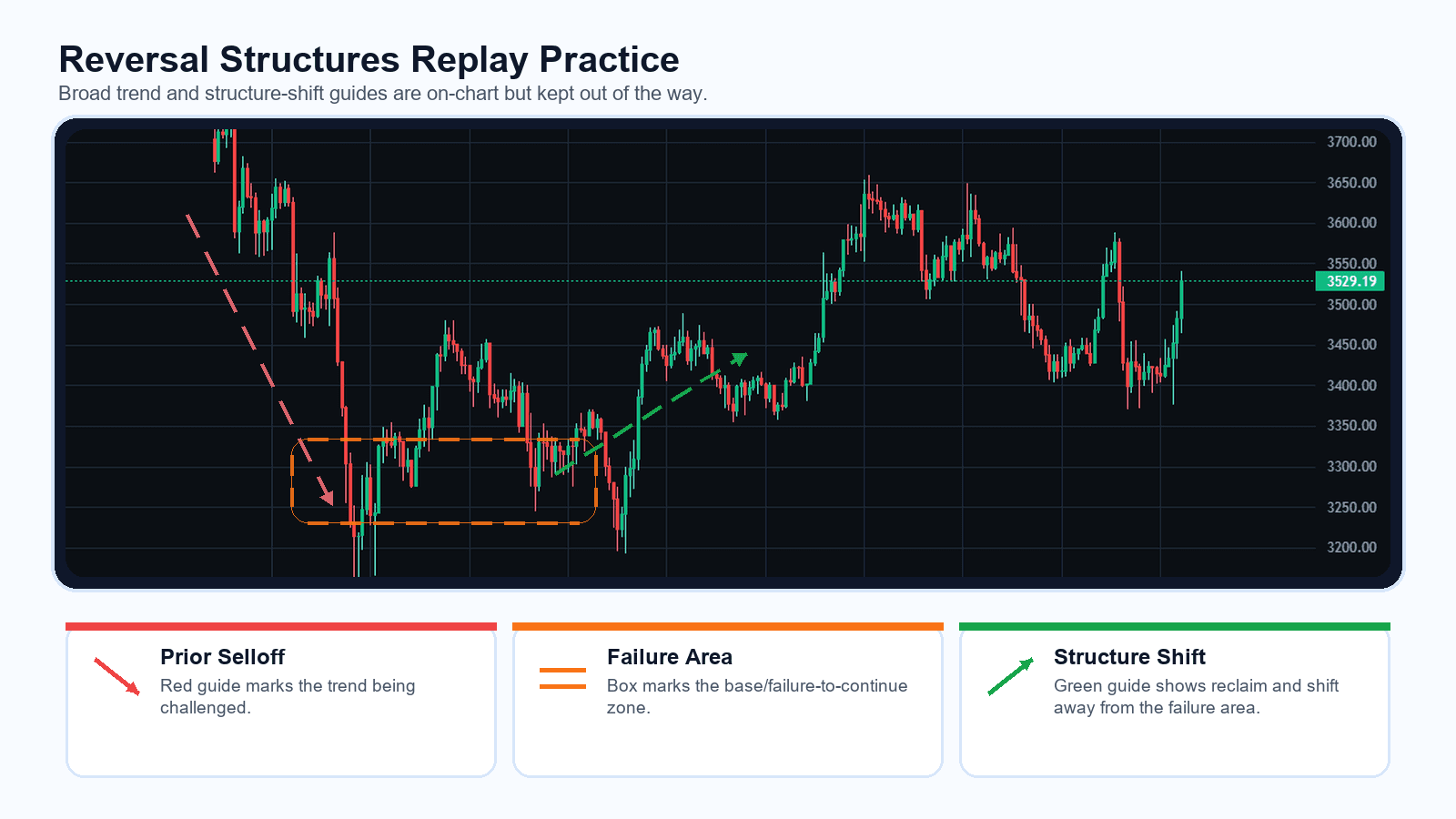
What a reversal structure should prove
A reversal structure has to prove that continuation is no longer the better read. That proof usually comes from structure damage, not from one dramatic candle.
| Reversal clue | Useful question | Weak version |
|---|---|---|
| Trend failure | What part of the prior trend stopped holding? | One counter candle after a strong move |
| Structure shift | Did price break the level that protected continuation? | A tiny local break inside noise |
| Follow-through | Did the new direction expand with intent? | Reversal candle stalls immediately |
| Invalidation | Where is the reversal idea wrong? | No clear point where the idea fails |
That is why the Reversal Structures setup hub is best used with a review rule: no reversal label unless you can name the structure that changed.
Reversal structure versus trend continuation
Reversal and continuation often look similar at the first pause. The difference appears in what the next sequence does.
Comparison snapshot
Pause inside trend or real reversal?
The same slowdown can either reset the trend or start a full structure shift.
Trend continuation
The old structure holds
- Pullback stays controlled.
- The level protecting trend remains intact.
- Continuation returns with displacement.
Reversal structure
The old structure fails
- The trend fails to continue after a meaningful test.
- Structure breaks against the prior direction.
- Follow-through confirms the new bias.
If you misread this often, pair this guide with SOL Trend Continuation Replay Guide. The comparison is useful because strong continuation and early reversal attempts often begin with the same pause.
How to practice reversal structures in replay
The practice question should be narrow:
Has the trend actually failed, or am I trying to predict a turn?
Practice workflow
Reversal structure replay workflow
- Mark the level or structure point that keeps the prior trend valid.
- Wait for price to test or break that structure before calling reversal.
- Watch whether follow-through confirms the new direction or continuation returns.
- Journal whether the mistake was early fade, late confirmation, weak invalidation, or poor context.
This works especially well after reading BTC Market Structure Shift Replay Guide, because that page gives the broader structure-shift lens.
The confirmation stack
A cleaner reversal structure usually stacks three confirmations:
-
Failure to continue
The prior trend attempts continuation but cannot make meaningful progress. -
Structure break
Price breaks the level that supported the old trend logic. -
New-direction displacement
The market moves with intent after the structure shift instead of drifting sideways.
You do not need perfection, but you do need enough evidence that the reversal is more than a reaction candle.
Review checklist
Reversal structure review checklist
- What exact structure point kept the old trend valid?
- Did that structure actually break or only get tested?
- Was there follow-through after the reversal signal?
- Did I call reversal before the market proved continuation had failed?
Common reversal mistakes
These show up repeatedly in replay:
- fading a trend because it looks extended
- treating one long wick as a full structure shift
- ignoring continuation displacement after a shallow pullback
- moving the invalidation after the idea starts failing
- labeling hindsight tops and bottoms that were not readable in the decision window
The last one matters because hindsight makes reversal structures look cleaner than they felt at the decision point. For traders, the real problem is timing the confirmation without inventing certainty.
How to journal reversal reads
A weak journal note says:
Reversal did not work
A useful note says:
Called reversal after first bearish candle, but the higher-low structure never broke. Continuation returned with displacement. Next session: require structure break plus follow-through before fading trend.
That note can feed directly into How to Review Replay Trading Mistakes and How to Turn Journal Notes Into Next Session Rules.
Where this setup fits
Use reversal structures after you understand the core practice loop:
- How to Practice Price Action Trading
- BTC Market Structure Shift Replay Guide
- SOL Trend Continuation Replay Guide
- Trading Journal Workflow for Setup Review
That cluster prevents the biggest reversal mistake: studying turns without studying the continuation logic they are supposed to defeat.
Bottom line
A reversal structure is valid only when the prior trend loses its structure and the new direction proves itself with follow-through. Replay makes that trainable because you can freeze the chart before confirmation is obvious and review whether the reversal call was earned or only predicted.
Next step
Replay price action setups inside SkillCandle
Move from reading about the setup to actually practicing it with a partial chart, replay reveal, and tracked review notes.
FAQ
Questions traders ask about this topic
What is a reversal structure?
A reversal structure is a sequence where the prior trend fails, price shifts structure, and follow-through confirms that the market is no longer behaving like continuation.
Is one opposite candle enough to confirm reversal?
No. One opposite candle can be a pullback. A stronger reversal needs trend failure, structure shift, and follow-through.
Why should reversal setups be practiced in replay?
Replay helps traders wait for confirmation instead of fading trends too early just because the move looks extended.
What invalidates a reversal read?
If the old trend structure holds and continuation returns with displacement, the reversal read is weak and should be reviewed as premature.
Related Reads
Keep building the cluster
BTC Market Structure Shift Replay Guide
A replay-first guide to practicing BTC market structure shifts so you can stop calling every bounce a reversal and start reading genuine transition points.
SOL Trend Continuation Replay Guide
Use this SOL trend continuation replay guide to practice staying with the dominant move instead of forcing reversals every time momentum pauses.
How to Practice Price Action Trading
A crypto-first framework for practicing price action trading with replay, setup clustering, and review loops instead of random screen time.
How to Review Replay Trading Mistakes
Learn how to review replay trading mistakes the right way: label the error, isolate the failed read, turn it into a next-session rule, and retest it cleanly.