Range Expansion Breakout Trading Setup Guide
Practise range expansion breakouts in replay, covering compression, acceptance, follow-through, and the mistakes that turn expansion into chasing.
Key Takeaways
- Range expansion needs compression, a real break, and follow-through.
- The breakout candle matters less than whether price accepts outside the range.
- Replay helps separate real expansion from range-edge liquidity grabs.
- The best review compares breakout acceptance with failed breakout behavior.
A range expansion breakout trading setup starts with compression. Price moves inside a defined area, energy builds, and then one side finally leaves the range. The trap is assuming that every candle outside the range is real expansion.
The better question is: did price accept outside the range, or did it only grab liquidity around the edge?
Range expansion is worth practicing because it trains the difference between a market that is actually opening up and a market that is baiting late breakout traders.
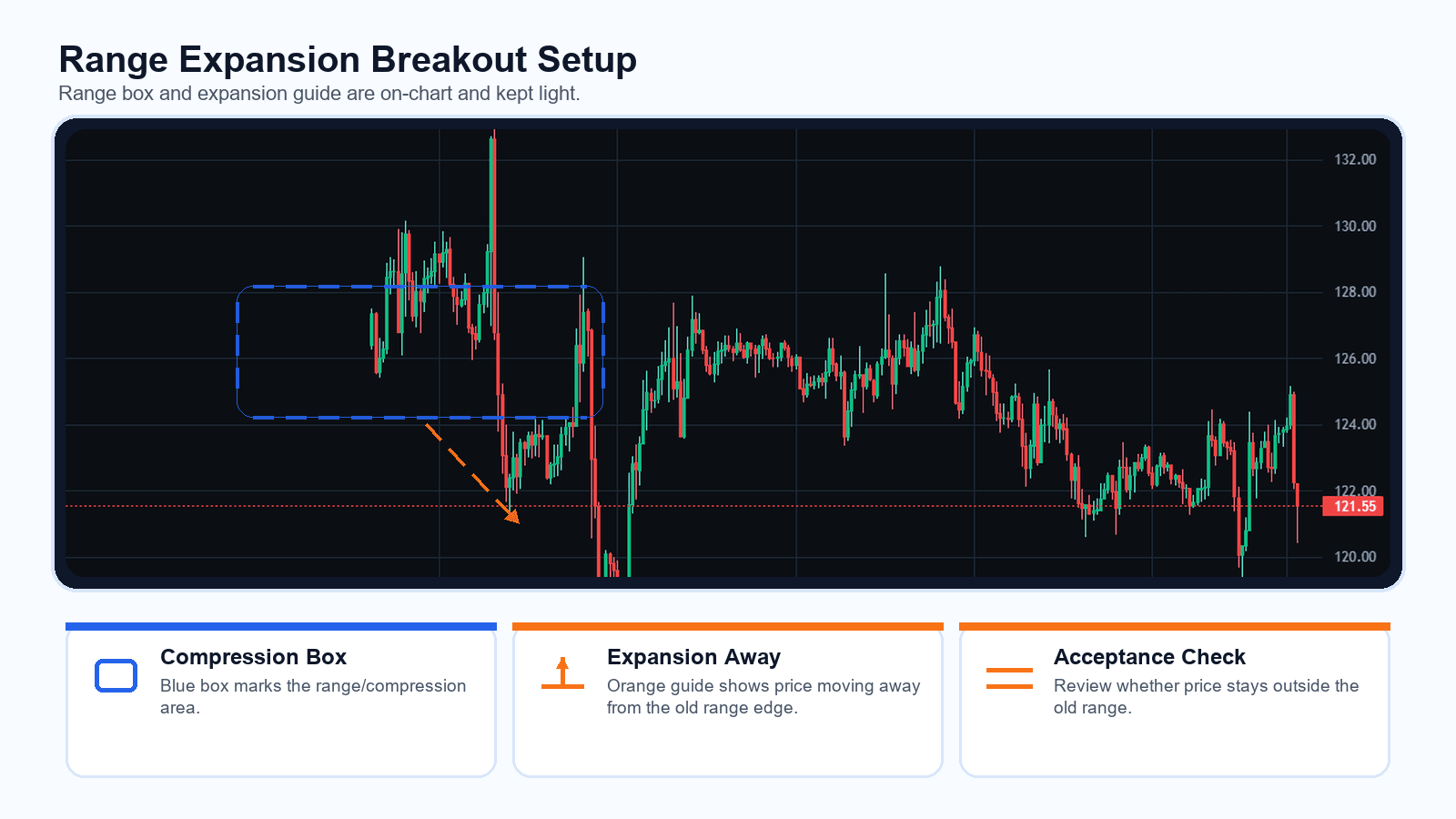
What range expansion really means
A range expansion breakout is a transition from low-quality overlap into directional movement. The setup usually includes:
- a visible range or compression zone
- a breakout close beyond the range edge
- follow-through that proves the break was accepted
- no fast return back into the old range
| Component | Strong read | Weak read |
|---|---|---|
| Range | Clear upper and lower boundary | Messy overlap with no clean edge |
| Breakout | Close outside the range with intent | One wick outside the range |
| Acceptance | Price holds beyond the boundary | Price returns inside immediately |
| Follow-through | Displacement continues after the break | Momentum stalls after one candle |
If the range is not clear, the breakout cannot be clean. This is why the first step in replay is marking the structure before the move reveals itself.
How to practice the setup in SkillCandle
Use the Range Expansion Breakout setup hub when you want pattern-specific examples. For the practice session itself, keep the question narrow.
Practice workflow
Range expansion replay workflow
- Mark the compression zone and its upper and lower boundary before the answer is visible.
- Watch whether the breakout closes outside the range or only wicks through the edge.
- Judge the next candles for acceptance, retest quality, and follow-through.
- Journal whether your read failed because the range was unclear, the break was weak, or acceptance disappeared.
This process keeps the setup out of hindsight. If you cannot mark the range before the breakout, you probably do not have a clean range expansion example.
Range expansion versus failed breakout
Range expansion and failed breakout are opposite outcomes from a similar starting point.
Comparison snapshot
Two outcomes after the range edge breaks
The same breakout candle can lead to continuation or failure. The difference is acceptance after the break.
Range expansion
The market accepts outside the range
- The range edge breaks with a meaningful close.
- Price holds outside the old boundary.
- Follow-through creates a new directional leg.
Failed breakout
The market rejects the breakout
- Price pushes outside the range but cannot hold.
- The move rotates back into the old area.
- Late breakout traders get trapped.
That is why this page should be paired with How to Read Breakout Failure in Replay. The best practice is not only finding breakouts. It is learning when not to trust them.
The acceptance checklist
Before you call the breakout real, ask:
- did the candle close outside the range?
- did the next sequence defend the broken edge?
- did follow-through continue after the first impulse?
- would the trade still make sense after stop and target are measured?
If the answer is weak, the setup may belong in the failed breakout bucket instead. Use Breakout Retest Trading Setup Guide when the chart breaks, retests, and continues. Use this guide when the main feature is a transition out of compression.
Review checklist
Range expansion review checklist
- Was the range clear enough to mark before the breakout?
- Did price close outside the range or only wick through it?
- Did the next candles accept beyond the boundary?
- Was there enough follow-through to justify calling it expansion instead of a fakeout?
Common range breakout mistakes
The most common mistakes are:
-
Trading the first wick outside the range
A wick can be a stop run. It is not automatically expansion. -
Using a messy range
If the boundary is unclear, the breakout read becomes too subjective. -
Ignoring return-to-range behavior
Fast acceptance back inside the range weakens continuation quickly. -
Forgetting the trade math
Even a good breakout can be late if the stop is too wide and the target is crowded. Check the Position Size Calculator before building live habits around the setup.
A simple weekly drill
Range expansion practice works well in short sessions:
Day 1: identify compression only, no entriesDay 2: judge breakout acceptance after the first close outside the rangeDay 3: compare two real expansions with two failed breakoutsDay 4: write one rule about when to skip weak range edgesDay 5: test the rule inside mixed Price Action Drills for New Traders
That rhythm trains both recognition and restraint.
Where this fits in the setup cluster
Range expansion sits beside:
- How to Practice Price Action Trading
- How to Read Breakout Failure in Replay
- Breakout Retest Trading Setup Guide
- Market Replay Trading Practice Plan
Those pages help you separate clean continuation, fakeout, and replay workflow instead of treating every breakout as the same setup.
Bottom line
The best range expansion breakout reads come from acceptance, not excitement. Mark the range first, wait for a real break, study whether price holds outside the boundary, and review the follow-through. Replay is the cleanest way to practice that decision before hindsight makes the answer look easy.
Next step
Replay price action setups inside SkillCandle
Move from reading about the setup to actually practicing it with a partial chart, replay reveal, and tracked review notes.
FAQ
Questions traders ask about this topic
What is a range expansion breakout?
A range expansion breakout happens when price leaves a compressed range with enough acceptance and follow-through to suggest the market is moving into a new active phase.
What confirms a range expansion breakout?
Stronger confirmation comes from a close outside the range, continued displacement, and no immediate acceptance back inside the old range.
Is a wick outside the range enough?
No. A wick outside the range can be a liquidity grab or failed breakout. A stronger range expansion needs acceptance beyond the range and follow-through.
Why practice range expansion in replay?
Replay helps you judge the moment between compression and expansion without hindsight, which is where traders often confuse one fast candle with real breakout quality.
Related Reads
Keep building the cluster
How to Read Breakout Failure in Replay
Read breakout failure in replay without hindsight, what to check before fading the move, and how acceptance and reclaim shape the read.
Breakout Retest Trading Setup Guide
Practise breakout retests in replay and learn whether a retest is constructive or already losing acceptance, with fewer false-breakout mistakes.
Price Action Drills for New Traders
Simple replay-based price action drills for new traders, using one setup, one market, and a review loop you can repeat every session.
How to Practice Price Action Trading
A crypto-first framework for practicing price action trading with replay, setup clustering, and review loops instead of random screen time.