Fake Liquidity Grab Continuation Guide
Tell trend-reset stop runs from true reversal sweeps and improve continuation reads around liquidity grabs using replay practice.
Key Takeaways
- Not every liquidity grab is a reversal; some are trend-continuation resets.
- The setup needs trend context, a grab against the trend, reclaim, and continuation displacement.
- Replay helps traders stop fading strong trends just because a wick took liquidity.
- Journal the difference between reversal sweep, failed breakout, and continuation grab.
A fake liquidity grab continuation is one of the easiest setups to mislabel. Price runs liquidity against the trend, traders assume reversal, and then the market quickly reclaims and continues in the original direction.
The direct answer: this setup is not about fading the trend. It is about recognizing when a stop run briefly shakes out one side before the dominant structure resumes.
That makes it different from a normal Liquidity Sweep Trading Example. A classic sweep often trains reversal thinking. A fake liquidity grab continuation trains the opposite: patience with trend after a temporary trap.
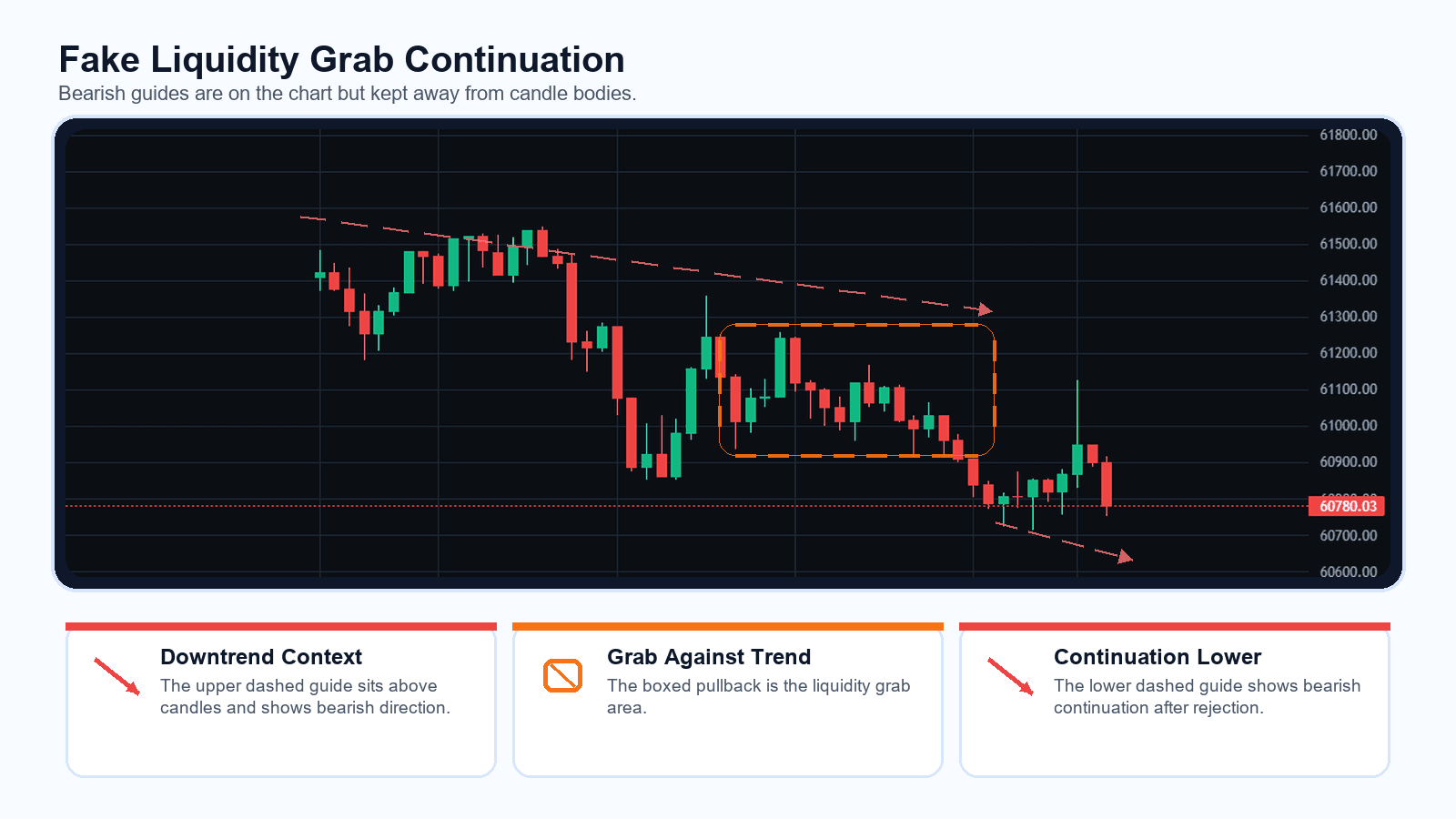
The simple model
The setup has four pieces:
Visual model
Fake liquidity grab continuation sequence
The grab matters only if the market reclaims and continues with the original structure.
Context
Trend exists before the grab
There should be a visible directional structure before the stop run happens.
Trap
Liquidity is taken against trend
Price sweeps a local high or low in a way that tempts reversal traders.
Reclaim
The market snaps back
The grab fails to build acceptance and price quickly returns toward the trend side.
Continue
Displacement resumes
Follow-through in the original direction proves the grab was a reset, not a full reversal.
If the trend context is missing, the setup becomes much weaker. A random wick in the middle of chop is not a continuation grab.
Continuation grab versus sweep reversal
This distinction is the whole setup.
| Question | Sweep reversal | Fake liquidity grab continuation |
|---|---|---|
| Prior context | Trend may be exhausted or range-bound | Dominant trend is still valid |
| Liquidity event | Stop run starts a directional shift | Stop run shakes out traders against trend |
| Confirmation | Reclaim plus displacement away from old trend | Reclaim plus displacement with the old trend |
| Mistake risk | Fading too early with no follow-through | Calling reversal when structure still supports continuation |
When you practice this, ask one direct question: did the grab damage trend structure, or did it only reset liquidity before continuation?
How to practice it in replay
Use the Fake Liquidity Grab Continuation setup hub for setup-specific pages, then run a short block where you are allowed to make only one decision: continuation or true reversal.
Practice workflow
Continuation grab replay workflow
- Mark the dominant trend before the liquidity grab appears.
- Identify the local high or low that gets swept against the trend.
- Watch whether price reclaims quickly or accepts beyond the swept level.
- Review whether continuation returned with displacement or whether the structure actually reversed.
That workflow pairs well with SOL Trend Continuation Replay Guide, because both setups punish premature reversal calls.
What confirms the setup
A stronger fake liquidity grab continuation usually has:
- trend structure already in place
- a stop run against that trend
- weak acceptance beyond the grabbed level
- fast reclaim back into the trend direction
- continuation displacement after reclaim
The reclaim is important, but it is not enough alone. If price reclaims and then goes sideways, the setup is still unproven.
Review checklist
Fake liquidity grab continuation checklist
- Was there a real trend before the grab?
- Did the grab happen against that trend rather than with it?
- Did price reclaim quickly after taking liquidity?
- Did continuation return with enough displacement to prove the trend was still active?
Common mistakes
The setup usually fails in review for one of four reasons:
-
Assuming every grab is a reversal
Stop runs can start reversals, but they can also refuel continuation. -
Ignoring trend structure
If higher lows or lower highs remain intact, the reversal call needs more proof. -
Entering before reclaim
The grab itself is not the confirmation. The reclaim and continuation matter. -
Mixing labels in the journal
If the note says "liquidity sweep" for every wick, the review will not separate reversal sweeps from continuation grabs.
A better journal note
A weak note says:
Liquidity grab, went up
A useful note says:
Bearish sweep looked like reversal, but higher-low structure held. Price reclaimed the swept low fast and expanded with the trend. Next session: do not call reversal unless the grab also breaks structure.
That note is useful because it names the difference between grab, reclaim, and continuation. For a wider review loop, pair this with How to Turn Journal Notes Into Next Session Rules.
Where this setup fits
Use this guide inside the price action cluster:
- How to Practice Price Action Trading
- Liquidity Sweep Trading Example
- Price Action Drills for New Traders
- Market Replay Trading Practice Plan
The goal is to stop treating every liquidity event as the same idea. Some grabs reverse. Some fail. Some continue the trend.
Bottom line
A fake liquidity grab continuation is a trend-context setup. The grab gets attention, but the reclaim and continuation decide the read. Practice it in replay by asking whether the stop run truly broke structure or only cleared liquidity before the dominant move resumed.
Next step
Replay price action setups inside SkillCandle
Move from reading about the setup to actually practicing it with a partial chart, replay reveal, and tracked review notes.
FAQ
Questions traders ask about this topic
What is a fake liquidity grab continuation?
A fake liquidity grab continuation happens when price sweeps against the main trend, reclaims quickly, and then continues in the original trend direction.
How is it different from a liquidity sweep reversal?
A sweep reversal changes direction after taking liquidity, while a fake liquidity grab continuation uses the stop run as a reset before the dominant trend resumes.
What confirms continuation after a liquidity grab?
The stronger confirmation is quick reclaim plus displacement back in the original trend direction, especially when the higher-timeframe structure remains intact.
Why do traders misread this setup?
Traders often assume every stop run must reverse, so they fade a strong trend instead of waiting to see whether the grab gets reclaimed and continues.
Related Reads
Keep building the cluster
Liquidity Sweep Candle Example
Learn how to read a liquidity sweep candle with replay-based review points so you stop mistaking every wick for a real sweep reversal.
SOL Trend Continuation Replay Guide
Use this SOL trend continuation replay guide to practice staying with the dominant move instead of forcing reversals every time momentum pauses.
How to Practice Price Action Trading
A crypto-first framework for practicing price action trading with replay, setup clustering, and review loops instead of random screen time.
Price Action Drills for New Traders
Simple replay-based price action drills for new traders, using one setup, one market, and a review loop you can repeat every session.