Breakdown Retest Replay Practice Guide
Practise breakdown retests in replay and learn to judge retest rejection, reclaim risk and continuation quality instead of chasing the first break.
Key Takeaways
- A breakdown retest is a continuation setup after support fails, not a signal to short every red candle.
- Retest quality matters more than the first breakdown candle.
- Replay helps separate failed reclaim, weak rejection, and real continuation.
- The best journal note names the exact level that failed and the reclaim signal that would have invalidated the idea.
Breakdown retest replay practice is useful because this setup looks obvious only after the continuation has already happened. In the live decision window, the first break below support can feel urgent, but the better question is simpler: did price retest the broken level and reject it with enough intent to justify continuation?
A breakdown retest is not just a bearish candle through support. The cleaner version has three parts:
- support fails
- price retests the broken level from below
- the reclaim attempt fails and downside continuation returns
That middle step is where most mistakes happen.
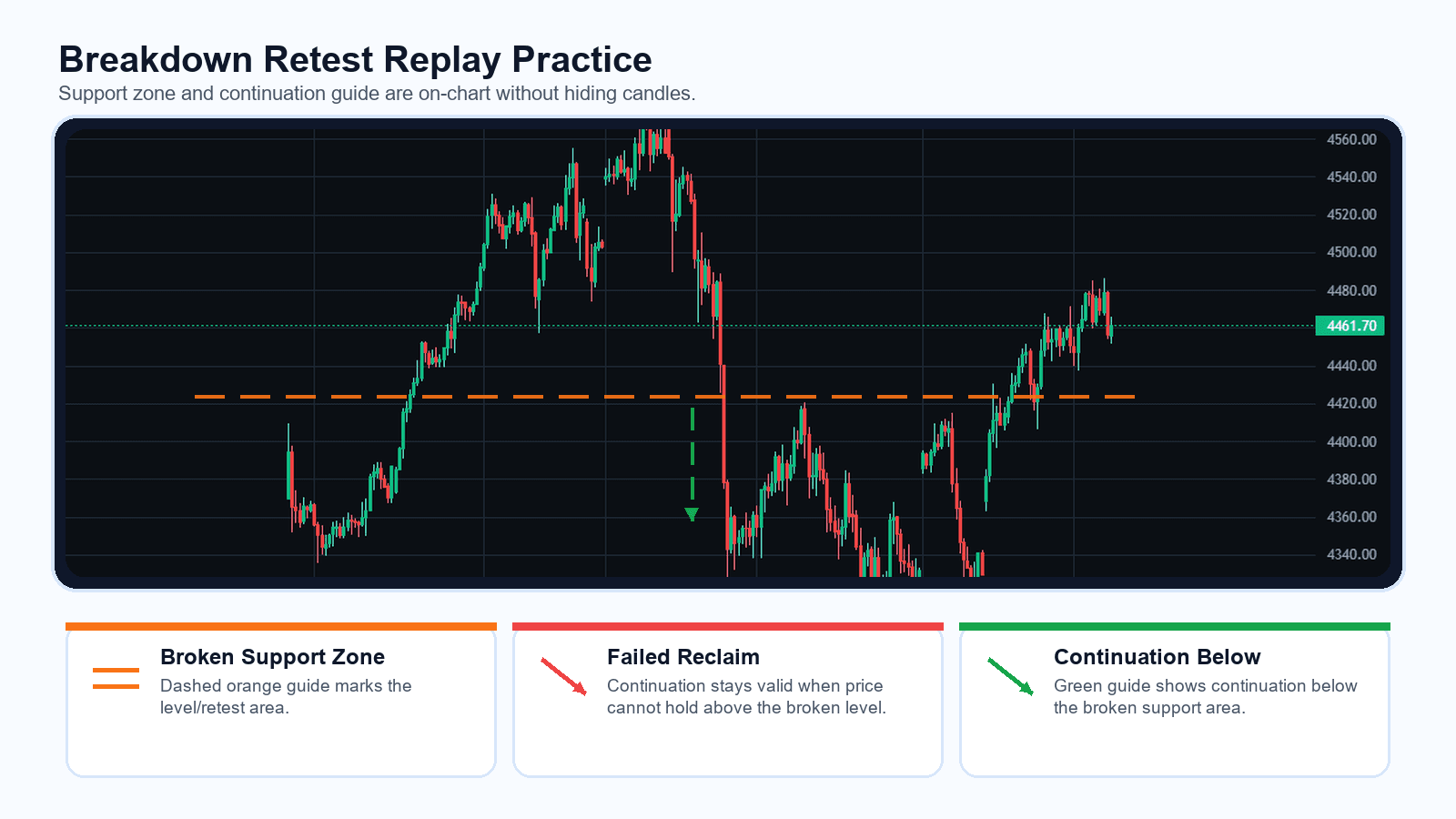
Quick definition
A breakdown retest trading setup appears when a market loses a meaningful support area, comes back to test that old support, and then treats it as resistance. The setup is stronger when the retest fails cleanly and continuation follows with displacement.
| Breakdown stage | What to check | Weak version |
|---|---|---|
| Support break | The level breaks with a close or clear displacement | A wick pokes through and instantly returns |
| Retest | Price returns to the broken area without reclaiming it cleanly | Price trades back above the level and accepts |
| Rejection | Momentum resumes away from the level | Price stalls with no follow-through |
| Review | The invalidation is obvious before entry | The stop is placed after the trade feels wrong |
The best SkillCandle practice question is not "is this bearish?" It is "does the broken support reject on the retest, or is the market reclaiming the old range?"
How to practice a breakdown retest in replay
Use the Breakdown Retest setup hub when you want more examples, then keep the actual practice block narrow. The goal is not to find every bearish candle. The goal is to judge one repeated sequence well.
Practice workflow
Breakdown retest replay workflow
- Mark the support level that actually failed before you reveal the next candles.
- Wait for price to retest the broken area instead of chasing the first breakdown candle.
- Judge whether the retest rejects, reclaims, or drifts sideways back into the old range.
- After the reveal, write whether the setup failed because of weak break quality, poor retest rejection, or a late entry.
That review loop is what turns the setup into a trainable read. If you skip the retest and only react to the first break, the practice becomes momentum chasing.
Breakdown retest versus breakout retest
Breakdown retests and breakout retests are mirror images, but they create different emotional traps.
Comparison snapshot
Retest direction comparison
Both setups are about acceptance after a level breaks. The difference is which side of the level must hold.
Breakout retest
Old resistance becomes support
- Price breaks above resistance.
- The retest holds above the old level.
- Continuation resumes upward after acceptance.
Breakdown retest
Old support becomes resistance
- Price breaks below support.
- The retest fails below the old level.
- Continuation resumes downward after rejection.
If you are mixing both in one session, read Breakout Retest Trading Setup Guide first, then compare it with this page. The most valuable replay block is often the one where you study why one level held while another failed.
What makes the retest tradable
A cleaner breakdown retest usually has:
- a level that was visible before the breakdown
- a break that does more than barely pierce support
- a retest that fails to reclaim the level
- renewed selling pressure after rejection
- enough room for the trade to make sense after the stop is defined
That last point matters. A valid setup can still be a poor trade if the continuation path is too crowded. Use the Risk Reward Calculator before treating the pattern as actionable.
Common breakdown retest mistakes
The repeated errors are easy to spot in replay:
-
Chasing the first breakdown candle
The first break creates interest, but the retest confirms whether the market accepts the move. -
Ignoring reclaim risk
If price reclaims the broken level and holds above it, the continuation idea is much weaker. -
Calling every lower high a retest
A real retest should connect to a meaningful broken level, not just any small pullback. -
Reviewing only the final move
The useful question is what was knowable before the continuation candle printed.
Review checklist
Breakdown retest review checklist
- Was the broken support level clear before the move happened?
- Did the breakdown close or displace below the level, or only wick through it?
- Did the retest reject the old support area from below?
- What exact reclaim signal would have invalidated the short continuation idea?
How to journal the setup
A weak journal note says:
Breakdown retest failed
A useful journal note says:
Support broke, but the retest reclaimed the level and held above it for three candles. I treated the first break as confirmation instead of waiting for rejection. Next block: require failed reclaim before calling continuation.
That level of detail connects this guide to How to Review Replay Trading Mistakes and Trading Journal Workflow for Setup Review. The goal is not to describe the chart. The goal is to extract the rule that changes the next replay block.
Where this setup fits
Breakdown retest practice sits between three SkillCandle topics:
- How to Practice Price Action Trading for the full replay loop
- How to Read Breakout Failure in Replay for acceptance and reclaim logic
- Market Replay Checklist Before Live Trading for deciding whether a setup is ready to risk
Use those pages together when you want to train level acceptance instead of memorizing pattern names.
Bottom line
The best breakdown retest reads come from patience after the first break. Mark the support, wait for the retest, judge the failed reclaim, and only then decide whether continuation is strong enough to matter. Replay makes that sequence honest because the answer is not visible yet.
Next step
Replay price action setups inside SkillCandle
Move from reading about the setup to actually practicing it with a partial chart, replay reveal, and tracked review notes.
FAQ
Questions traders ask about this topic
What is a breakdown retest setup?
A breakdown retest setup happens when price loses a support level, returns to test that broken area from below, and then rejects instead of reclaiming the level.
What confirms a breakdown retest?
A stronger confirmation is a failed reclaim at the broken level followed by renewed downside displacement, not only the first candle that breaks support.
Why is replay useful for breakdown retests?
Replay lets you pause between the breakdown and the retest so you can judge whether continuation is actually accepted before the final move is visible.
What invalidates a breakdown retest idea?
A clean reclaim above the broken level, weak rejection after the retest, or immediate sideways acceptance back inside the old range can invalidate the continuation idea.
Related Reads
Keep building the cluster
How to Read Breakout Failure in Replay
Read breakout failure in replay without hindsight, what to check before fading the move, and how acceptance and reclaim shape the read.
Breakout Retest Trading Setup Guide
Practise breakout retests in replay and learn whether a retest is constructive or already losing acceptance, with fewer false-breakout mistakes.
How to Practice Price Action Trading
A crypto-first framework for practicing price action trading with replay, setup clustering, and review loops instead of random screen time.
Market Replay Checklist Before Live Trading [Session Checklist]
Use this session checklist before live trading to confirm the setup read, invalidation logic, and review process are stable enough for real risk.